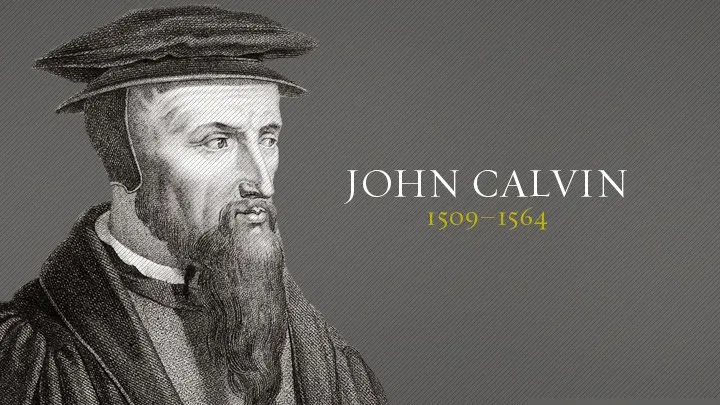
Earlier this year, I started a series of short biographies called “bite-sized bios.” My entire goal is to introduce us to some heroes of our faith to encourage us to remember God’s faithfulness. We are not the first ones to live the Christian life. And unless Jesus returns, we won’t be the last. Our God has not failed His church. In the darkest times, His Word has done the work of preserving His people.
Now, perhaps no one in Church history is as polarizing a figure as John Calvin. Even his name brings either a cringe or a joy.
But what I want to help us do, regardless of where we personally stand on some of the details of Calvin’s theology, is to see that John Calvin was a great tool in God’s hand.
John Calvin is best known as the author of The Institutes of the Christian Religion. It is his magnum-opus. This multi-volume systematic theology is a masterpiece. Calvin was a deep and Christ-centered theologian.
John Calvin was born on July 10, 1509 in Noyon, France.
Very little is known of Calvin’s early life. But it’s clear he was brilliant.
When he was 14 years old, his father sent him to study theology at the University of Paris. 4 years later, when Calvin was 19 years old, his father urged him to quit theology and study law, which he did even though he didn’t want to.
Just think about this time period. 1517 is when Luther nailed the 95 theses on the door of the church in Germany. So, as Calvin is growing up and learning theology in the Catholic church, the Reformation has already started.
We don’t know the exact details, but sometime in the early 1530s (when he was in his early 20s), Calvin was converted to Christ and began to embrace the Reformation teaching. In 1533 he had to flee the city of Paris because of persecution of those who held Lutheran-like doctrines.
After escaping Paris, Calvin went to Switzerland. While in exile there, in 1536 (same year that William Tyndale was burned at the stake), he wrote the first edition of The Institutes of the Christian Religion. It would go through 5 enlargements before reaching its present form in 1559.
We tend to think of systematic theology books as merely academic. But for Calvin this was a matter of life and death. People were dying for their beliefs. Persecution was rampant. So, Calvin wrote to defend the doctrine of the Bible that so many were dying for.
Well, after returning to and fleeing from France again, Calvin ended up in Geneva.
Calvin wanted to spend his days in the quietness of study and thinking. But God had other plans for John Calvin. After a friend threaten to pray for God to curse his studies, he became a pastor in Geneva.
Now, he had to flee Geneva because of persecution and ended up in Strasbourg for about 3 years where he pastored and found his wife, Idelette. Calvin was 31 years old and Idelette was a widow who was part of Calvin’s church. She brought a son and daughter with her into their marriage.
Well, the leaders of Geneva rescinded the ban on Calvin in 1541, so they went back there and he resumed his pastorate.
It was about then that Calvin developed a personal motto. He had an emblem made that he would use to stamp his letters that had a picture of a hand holding a heart to God with the inscription prompte et sincere (“Promptly and sincerely”). His whole life was offered to God as a sacrifice.
Calvin and Idelette had a son who died 2 weeks after his birth in 1542.
Calvin wrote to a friend, “The Lord has certainly inflicted a severe and bitter wound in the death of our baby son. But He is Himself a Father and knows best what is good for His children.” This is the kind of submission to the sovereign hand of God that Calvin rendered in all his countless trials.
His wife was never well after this. They had 2 more children die at or soon after birth. Then in 1549, Idelette died of what was probably tuberculosis. Calvin promised her 3 days before her death to take care of her children from her first marriage.
Calvin’s health suffered greatly. He often spit blood and had gout and dealt with severe kidney stones.
He also was constantly under the threat of persecution and physical harm. There would often be mobs of people outside his house threatening to throw him in the river or shoot him with a musket.
And in all these trials, Calvin faithfully preached God’s Word and pastored his people and trained leaders. He faithfully exposited God’s Word…sometimes preaching multiple times every day and averaged about 10 sermons every 2 weeks.
And Calvin preached consecutively through books of the Bible.
I love the example of when he was banished in 1538. He preached on Easter and then had to leave the city for over 3 years. He returned in September 1541 and exposited the very next verse…that he had finished on 3+ years earlier.
Calvin believed God’s Word was the key to knowing and enjoying God and seeing the majesty of Jesus Christ. Everything hinged on the people of God knowing the Word of God for John Calvin.
Here is how he challenged the pastors of his day and ours:
“Let the pastors boldly dare all things by the word of God. . . .
Let them constrain all the power, glory, and excellence of the world to give place to and to obey the divine majesty of this word.
Let them edify the body of Christ.
Let them devastate Satan’s reign.
Let them pasture the sheep, kill the wolves, instruct and exhort the rebellious.
Let them bind and loose thunder and lightning, if necessary, but let them do all according to the word of God.”
Well, Calvin’s health became very poor in 1564.
He managed to attend the Lord’s Supper on Easter Sunday, though he had to be carried to the service on a chair. In April, he was confined to his sickbed.
On April 25, 1564, Calvin dictated the following words:
“I render thanks to God, not only because he has had compassion on me, His poor creature, to draw me out of the abyss of idolatry in which I was plunged, in order to bring me to the light of His gospel and make me a partaker of the doctrine of salvation, of which I was altogether unworthy, and continuing His mercy He has supported me amid so many sins and short-comings, which were such that I well deserved to be rejected by Him a hundred thousand times—but what is more, He has so far extended His mercy towards me as to make use of me and of my labour, to convey and announce the truth of His gospel.”
And a month later, on May 27, 1564, at 54 years old, his close colleague, Theodore Beza, found John Calvin had died in his sleep.
He was buried in Geneva in an unmarked grave, per his request.
Write a Comment
Comments for this post have been disabled.